Out of Office
In true Gen Z fashion, our entrance into the workforce had to be accompanied by a portmanteau phrase to encompass the complex thoughts, feelings and experiences that come with such a transition - in this case, the office siren (not a real portmanteau I know, but the general purpose is similar).
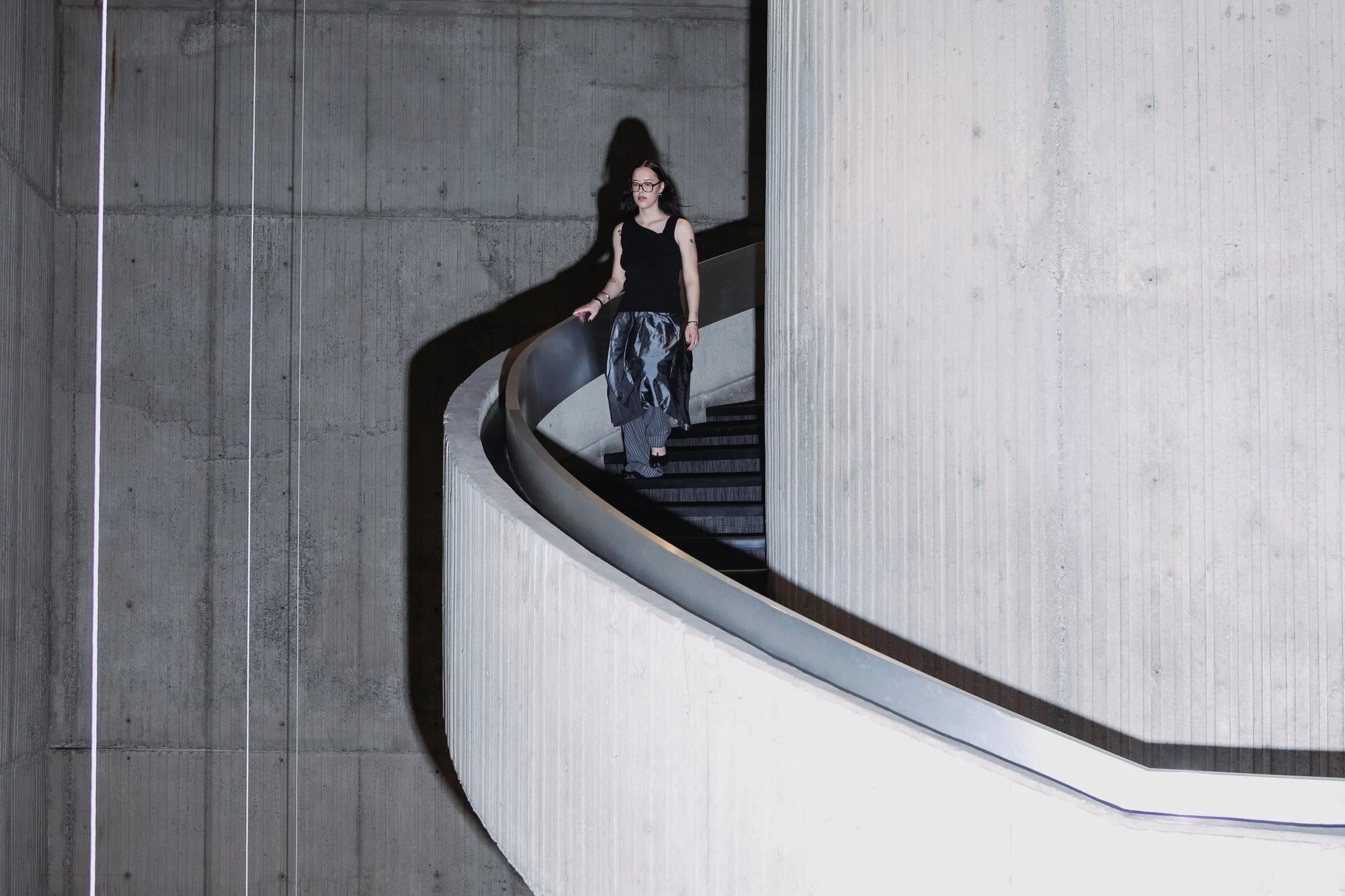
Characterized by sharp, tailored lines, 90s/Y2K silhouettes, menswear elements and tiny frame glasses, the office siren materializes as the sexy, working woman of our childhood imaginings. She is what I thought young adulthood and womanhood would be - alluring femininity, mystery and independence.
Whether originally proposed as an off-the-clock look or a true workwear wardrobe, we may never know. But the trend quickly took off, and inadvertently brought issues regarding gender and the workplace forth for a new generation of employees. The clunky, almost comical juxtaposition between “office”, a pure construction of the modern world defined by profit, productivity and the suppression of self (as I will later argue) and the siren, a mythical creature embodying the call of our base desires and the pull of feminine sexuality. It’s no wonder such a trend was doomed from the start.
Some young women took it very literally, showing up to their places of work in micro-mini pencil skirts or plunging necklines. The office siren trend made headlines for getting successful women fired from their high-paying jobs, stories that we would read and shake our heads at in disbelief and pity. How could she think it was appropriate to wear something like that to the office? She must want to attract attention to herself.
It’s true that the trend implies a desire to take on a certain alluring yet unattainable presence in the workplace. But I actually think it speaks to a deeper desire - just as a siren cannot stifle her innate appeal and sexuality, the office siren trend could be perceived as a resistance against the office setting’s requirement to neuter and neutralize our bodies, desires and humanity. The situation brings forward the age-old conundrum of the dress code. I remember as a middle school student being stopped in the hall by our male principal who told me my skirt was too short - I will never forget the feelings of shame, fear and embarrassment that filled me in that moment. But most of all, I was confused. At that time, I could only understand the assessment of the appropriateness of someone’s attire as being informed by a feeling of attractiveness or “sexiness” that it inspires. This made me fearful and painfully aware that I was being perceived not as a person, but as my body, primarily. As a straight-A student with a deep desire to please my teachers, an admonishment from the principal who had never once spoken to me about my high performance in school made me immediately feel that my body and appearance trumped my hard work, passion and intelligence. I was reduced to a girl who wanted to show off her body, who needed to be reprimanded. I’m sure many women have had this experience.
I have come to understand the conversation of dress code to be more nuanced than how I did at that time. I believe that women face pressure at a young age to appear attractive and sexy, and are told that they will receive perks or benefits for doing so. Ironically, an event like the above further solidifies my realization that my value is derived primarily from my appearance - it is what people will notice first, value first or write off first. But I don’t say this to defend dress code policies - rather, I think it’s important to teach young women that there is no such thing as an inappropriate body and that all bodies are worthy of respect and care, alongside education about how the way we dress might unconsciously be driven by the desire to appeal to the world and therefor ease our path - a myth, of course, but one that I think it quite prevalent.
The example I provided is juvenile, but it applies to the office space as well. As we young women enter the workplace, we are faced with the challenge of reconciling our self expression with the business-casual dress code. What this reveals to many of us is that our personal style is closely linked to creating, highlighting and accentuating appeal. The office siren trend provides a middle ground, suggesting that it’s possible to appeal within the confines of the office dress code.
This is partially true. Fitted, low waist trousers and collared shirts, tailored blazers and kitten heels are technically office-appropriate. But I believe that we can also look at the office setting as an opportunity to experiment with modest fashion and exercise further divorcing our personal style from the need to flatter or show our assets to their best effect. I want to reiterate that there’s nothing wrong with dressing sexy or “immodestly” - rather, I’m proposing that on the other side of those style-drivers may be new inspirations to expand the repertoire of our personal style.
At the root of the office siren trend is the desire to express oneself in the workplace. For Gen Z, the transition to the workplace has been fraught. From online classes weakening our social muscle to remote internships robbing us of an introduction to the office setting, many young people struggle to not only figure out how to express themselves at work but also how to be themselves as a working adult. Work life balance and the 5 to 9 are on many folks' minds, especially with the economy forcing many to take on jobs that are not well aligned with their goals or interests.
I’ve seen some respond by taking on a work persona, or even more extreme, stripping themselves of personality for each work day. No photos or plants at the desk, the same uninspired outfit worn like a uniform each day, never speaking about their life or passions with coworkers. Others take on a mysterious air, withholding information to provide an incomplete and intriguing impression.
And it’s no wonder why - offices neuter the organic, uncontrolled, natural and raucous, stifling creativity in the face of productivity. The accompanying photoshoot was captured at Detroit’s Renaissance Center, a relic of 80s office culture. Giant LCD screens project undulating scenes of natural landscapes, fish in the sea, and rippling leaves alongside automotive imagery. At every corner, plants in geometric planters burst forth from gray carpeting and concrete. Skylights and floor-to-ceiling windows display river and sky at a safe, untouchable distance.
The intention of the renaissance building was to create an office space that employees would not need to leave once throughout the day. The food court and cafe take care of meals, and the massive, convoluted structure allows workers to ramble and wander almost as if outside (the building is so large it has its own zip code).
It’s the perfect example of what the office space is in America - a simulated reality, or rather, a hyperreality. As Guy Debord explored in his essay The Society of the Spectacle, hyperreality is defined as a postmodern concept where the distinction between what is real and what is a simulation becomes indistinguishable. It is the practice of removing all that is natural and returning it piecemeal, fragmented, and on the creator’s own terms - tropical plants in the middle of the midwest, views of the river and natural light without the wind or rain, visions of the great wide world from the comfort of your office.
The office dress code is an extension of this - a uniform for simulated reality, where we play a fragmented human character. We eat, drink and breathe like a human, but we do not think as a human would think or do as a human would do. We stare at screens, or backs hunched and our shoulders drawn to our ears. We sit for hours at a time, getting up to get more coffee that will fuel our focus. We encase ourselves in structured, itchy, stifling layers that conceal our form and render us nonhuman and therefore “appropriate.”
Like I mentioned, I have tension with the idea of the office siren as a figure of allure and desire. But what I am interested in is the office siren as an infiltration of the sterile with the organic, the human and the natural. How can we dress in a way that checks the boxes of appropriateness but also expresses our creativity and therefore our humanity? Whether this is a fitted trouser that beautifully flatters the line of your leg or a layered explosion of textures and silhouettes, we can understand such dress as a subtle rebellion against the sterility of the office setting.